Ninety Minutes, No Consultants: A Wargaming Drill Your Own Staff Can Run
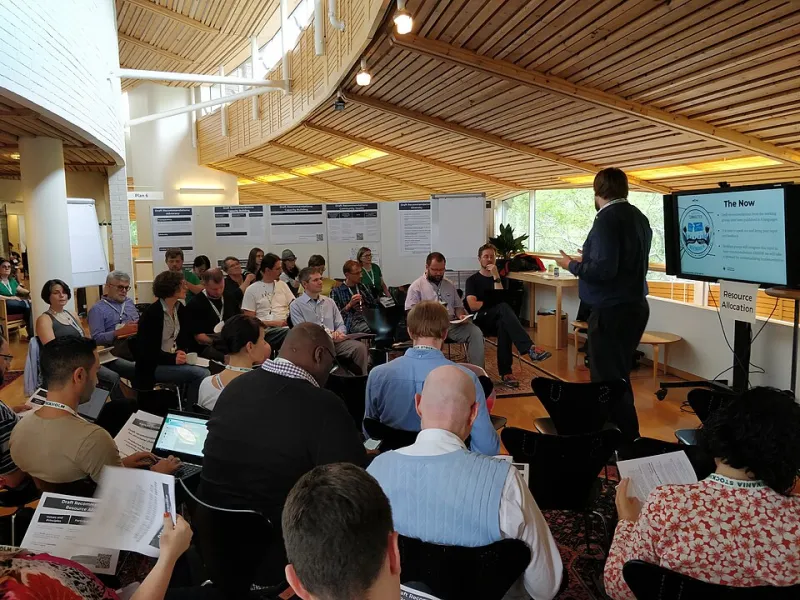
Photo: Nicole Ebber, CC BY-SA 4.0, via Wikimedia Commons
Most competitive response planning happens in the wrong order. A rival moves, the leadership team convenes, and the discussion becomes an exercise in explaining a decision that has already been made by someone else. The alternative is inexpensive and unglamorous: a structured 90-minute session, run in-house, that forces your own people to think like the other side before the other side has acted.
The format below has one design constraint worth stating up front. It must fit inside a single meeting block, because anything longer will be rescheduled twice and then quietly abandoned.
Why the Drill Beats the Deck
A competitive analysis deck is a product. It presents a conclusion and invites agreement. A wargame is a process. It produces disagreement, and disagreement is the raw material of contingency planning. The distinction matters most in the quarter before a pricing change, a product launch, or a capacity decision, when the organization has already committed emotionally to a direction and needs its assumptions attacked while retreat is still cheap.
Internal staff are better suited to this than outside facilitators for a specific reason: they hold the tacit knowledge that no consultant can acquire in a two-week engagement. The sales director knows which accounts are genuinely loyal and which are waiting for a reason to leave. Procurement knows which supplier commitments are renegotiable. Finance knows which segment margins have no room left. The drill's job is to put that knowledge under pressure.
Who Sits at the Table
Four to six people, no more. Composition matters more than seniority.
- Sales or account management — the customer's actual voice, and the person who knows where the deals are fragile.
- Finance — the constraint that ends most strategic fantasies.
- Product or operations — the person who can say how fast something can genuinely be built or changed.
- Procurement or supply chain — the source of capacity, lead-time, and cost realities.
- A moderator — ideally not the most senior person in the room.
Include one executive with real decision authority, but seat them as an observer for the first hour. A vice president who speaks at minute eight converts the exercise into a briefing.
The 90-Minute Clock
Minutes 0–10: Frame the single move. State one competitive action under consideration, in one sentence, with a date attached. Not a theme. A move. Example: We raise list price eight percent on the mid-tier line effective the first week of Q1. Anything broader will generate abstraction instead of analysis.
Minutes 10–30: Red cell. Half the group plays the competitor. Their only job is to answer four questions on paper: what do we do in the first thirty days, what do we do in the first ninety, what do we tell customers, and what do we tell our board. No hedging language permitted.
Minutes 30–50: Blue cell response. The remaining participants respond to each red action in sequence. The moderator enforces a rule: every response must name a cost and an owner.
Minutes 50–65: Second move. The red cell reacts to the blue response. This is where the exercise earns its value, because most organizations plan one move deep and are surprised by the counter-move.
Minutes 65–80: Assumption kill list. The group names the three beliefs the entire exercise depended on, and rates each one's evidentiary basis as strong, thin, or unexamined. Any item marked unexamined becomes a collection requirement with a deadline.
Minutes 80–90: Write the memo. One page, produced in the room, before people disperse. What we expect, what we will do if it happens, what would change our minds.
Where These Sessions Fail
Three failure modes account for nearly all wasted drills.
Politeness. Red cells staffed by people who like their colleagues produce competitors who behave like reasonable versions of ourselves. Counter this by assigning the red role to the participants with the least stake in the outcome, and by requiring the red cell to write its moves before the blue cell speaks.
Strategy vocabulary. Language like leverage our differentiation is a refusal to answer. The moderator should translate every sentence into a verb, a date, and a dollar figure, or strike it.
No decision-maker. A drill without an executive in the room produces a memo nobody acts on. The observer role exists to preserve the quality of the discussion, not to remove accountability from it.
Cadence and Follow-Through
Run the drill once per quarter, in the two weeks before the quarter opens. Keep a running log of predictions and outcomes. Within two or three cycles, the log becomes the most credible calibration instrument the intelligence function owns — a record of where the organization systematically overestimates its rivals' speed and underestimates their willingness to absorb margin.
The output is not a forecast. It is a prepared set of responses, agreed in advance by the people who will have to execute them under time pressure. That is a modest asset, and it is considerably cheaper than discovering the same answers in the four days after a competitor's announcement, when the only remaining options are reaction and regret.